Share


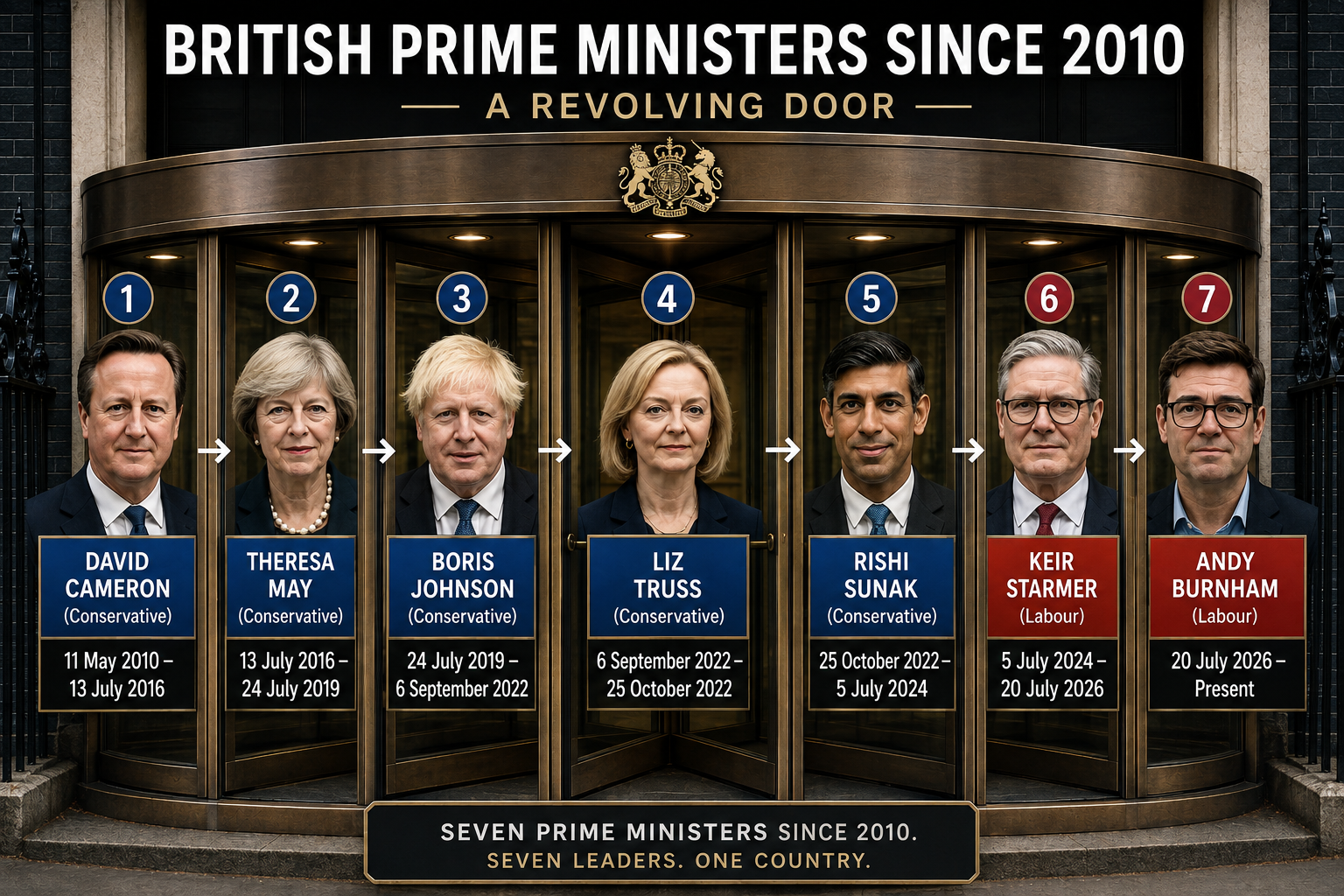
Every new occupant of Downing Street arrives promising renewal: stronger growth, better public services, lower taxes, controlled borrowing, stronger defence and, somehow, a country in which ordinary people feel more prosperous. Then the Treasury opens its books.
Within months, ambition becomes “fiscal responsibility”, investment becomes “difficult choices” and reform becomes an argument about what can be cut. Approval ratings fall, backbenchers grow restless and before long the familiar question is being asked: is the Prime Minister simply not up to the job?
Perhaps we are asking the wrong question. The names change. The arithmetic does not.
Brexit did not cause every problem facing Britain. Covid, Ukraine, energy prices, an ageing population, weak productivity and decades of underinvestment all matter. But Brexit has made almost every one of those problems harder to solve because it has reduced the economic capacity with which Britain must confront them.
The Office for Budget Responsibility continues to assume that Britain’s post-Brexit trading relationship will leave long-term productivity around 4 per cent lower than it would otherwise have been, with UK trade intensity around 15 per cent lower.
Four per cent sounds modest until one remembers the size of a national economy. It means less investment, lower output and wages than would otherwise have existed, and ultimately a smaller tax base. The loss does not arrive at the Treasury as an invoice marked Brexit. It appears instead as the company that did not expand, the investment made elsewhere, the export order that became uneconomic and the tax receipt that was therefore never collected.
The Centre for European Reform has estimated that the economic damage associated with Brexit amounts to roughly £40 billion a year in lost tax revenue. It is an estimate based on a counterfactual—what Britain might have looked like had it remained—and should be treated as such. But its scale is striking because £40 billion is remarkably close to the territory in which Britain’s most painful political choices now sit.
NATO members have committed to reaching 3.5 per cent of GDP in core defence expenditure by 2035. For Britain, getting there from present plans would require tens of billions of pounds more each year. Allow roughly £30 billion and the comparison becomes uncomfortable: the remaining £10 billion would itself be enough to transform the finances of prisons, courts, policing, councils or social care.
That does not mean reversing Brexit would cause £40 billion to appear in the Treasury tomorrow. It would not. But it does reveal the opportunity cost. Britain is arguing over which essential service must surrender money to another essential service while carrying an economic loss of roughly the same order as the shortage it is trying to manage.
And unlike the cost of a pandemic or an energy shock, that loss is structural. It repeats.
This helps explain the increasingly short political half-life of British governments.
A Prime Minister enters office promising better hospitals, functioning schools, visible policing, stronger borders, competent councils and credible national defence. The Treasury then explains that the money is not there. The choices are familiar: raise taxes, borrow more, cut expenditure or abandon promises.
Usually governments attempt some combination of all four. Taxes rise, but weak growth limits what they yield. Borrowing provides room, but interest consumes an increasing share of the budget. Spending restraint damages services already under pressure. Promises are diluted, leaving voters wondering why changing the government changed so little.
Within a couple of years the administration looks exhausted. The Prime Minister is accused of weakness or incompetence and the governing party begins wondering whether another leader might fare better.
But replacing the Prime Minister does not replace the missing economic activity.
The next occupant inherits the same Treasury and essentially the same equation.
Image: Volodymyr Zelenskyy - President.gov.ua, CC BY 4.0 , via Wikimedia Commons.
Defence makes the contradiction particularly difficult to disguise. Europe faces its most dangerous security environment in decades. Britain must replenish ammunition, modernise equipment, recruit and retain personnel, strengthen infrastructure and prepare for a world in which European countries are expected to carry considerably more of their own defence burden.
All of that costs real money. Ships cannot be built from efficiency reviews and soldiers cannot be paid with ministerial announcements.
The money can come from higher taxes, but Britain’s tax burden is already high. It can come from borrowing, but debt and debt-interest costs constrain that route. It can come from existing public services, but hospitals, schools, courts, prisons and councils are hardly awash with surplus capacity.
Or it can come from welfare.
That last option is politically tempting because it can be presented as transferring money from those who do not need it to something the country plainly does need. But government finance is rarely so tidy.
Reduce support to a disabled person who cannot realistically work and the welfare budget may record a saving. If their health deteriorates, however, the NHS may inherit the cost. If the household loses its home, the council pays for temporary accommodation. If a child arrives at school hungry or distressed, the school must respond. If a relative leaves employment to provide care, the Treasury loses tax revenue while demand for public support may increase.
The expenditure has not necessarily disappeared. It has changed address.
Local government demonstrates this brutally. Councils must still meet statutory responsibilities for homelessness, vulnerable children and social care even when their finances are deteriorating. English councils spent about £1.27 billion on housing benefit for temporary accommodation in 2024–25 while receiving only £911 million in reimbursement. The Local Government Association has warned that the cumulative gap could approach £4 billion by 2029–30.
This is the danger of governing through departmental spreadsheets. A saving for the Department for Work and Pensions can become a bill for the NHS, a council, a school or the police. Britain does not necessarily spend less; it simply pays later, often when the problem has become more expensive.
The same pattern can be seen across government. A functioning prison system costs money, but so does an overcrowded and failing one. Social care is expensive, but so are hospital beds occupied because patients have nowhere suitable to go. Housing support costs money, but homelessness is hardly free.
Britain has become increasingly adept at postponing expenditure until it returns as an emergency.
That is perhaps the most revealing change in British politics. Governments are no longer principally arguing about which great national projects they wish to build. Increasingly they are trying to find enough money to maintain institutions that already exist.
Hospitals need staff and buildings. Schools need teachers. Police forces need officers and investigators. Courts need capacity. Prisons need cells and staff. Councils need sufficient resources to perform duties Parliament legally requires of them. Now the Armed Forces require substantially more as well.
Each claim is reasonable in isolation. Collectively they exceed what a weakly growing, heavily indebted economy can comfortably provide.
Which is why the political argument so often becomes dishonest. Britain cannot indefinitely combine European expectations of public services, much greater defence expenditure, relatively low taxes and fiscal restraint while accepting poor economic growth.
Something has to give.
Yet Britain continues to treat structural weakness as a recruitment problem. Perhaps the next Prime Minister will communicate better. Perhaps the next Chancellor will be tougher. Perhaps another efficiency review will discover billions that every previous review somehow overlooked.
It is an attractive idea because it means nothing fundamental has to change. We simply need better people managing the existing settlement.
But even an exceptional Prime Minister cannot repeal arithmetic. If economic output is lower, the tax base is lower. If revenue is lower, government must tax more, borrow more or spend less. When taxes are already painful, borrowing constrained and services visibly deteriorating, each choice carries an immediate political cost.
That is the logic of the two-year premiership: the period between promising Britain what it needs and discovering what the existing economy can actually afford.
This is why Britain’s relationship with Europe needs to be discussed differently from the way it was in 2016.
The important question is no longer whether somebody once identified as Leave or Remain. It is whether the economic settlement created by Brexit produces benefits sufficient to justify its costs.
The comparison with Britain’s subsequent trade agreements is revealing. The Government’s impact assessment of the Australia agreement estimated a long-term increase in UK GDP of around 0.08 per cent. That may be a worthwhile gain, but set beside the OBR’s assumption of a 4 per cent long-term productivity loss associated with Brexit, it illustrates the problem of scale.
Geography remains stubborn. Britain’s largest nearby market is Europe.
Rejoining the European Union would not be simple and would not instantly restore the economic activity lost since Brexit. Britain could not assume that its former rebates and opt-outs would return, membership would involve financial contributions and obligations, and negotiations would take years. There are also intermediate possibilities—closer regulatory alignment, reduced trade barriers and deeper participation in the Single Market—which deserve consideration on their own merits.
But the economic case for greater integration should no longer be dismissed as nostalgia. If Britain’s fundamental problem is that the economy is struggling to generate enough revenue to sustain what the country expects from the state, then improving access to its largest market is a fiscal question as much as a constitutional one.
Britain cannot cut its way indefinitely to prosperity. It cannot continually tax a weakly growing economy without consequences, borrow without limit, or fund defence, public services and an ageing population simply by slicing the same inadequate budget ever more thinly.
Eventually, the economy itself has to become larger.
That is the argument hiding beneath so many apparently separate crises. Defence, welfare, prisons, NHS waiting lists, council finances and taxation look like different problems, but increasingly they collide with the same constraint: too many demands chasing too little economic capacity.
Brexit is not responsible for all of that. But if the OBR is broadly correct, it has made the constraint considerably tighter.
Britain can change Prime Ministers. It can change Chancellors, fiscal rules, departmental names and five-year plans. What it cannot do is spend economic activity that never happened.
Until that arithmetic changes, Downing Street may continue to operate a revolving door.
Different leader. Same Treasury. Same equation.
Gulvinder “Gully” Bansal is a product and transformation leader based in Codsall, Staffordshire, where he lives with his wife and two children.
Professionally, Gully has spent much of his career working where technology, business and people meet, with experience spanning retail, manufacturing, digital commerce, supply chain and large-scale organisational change. More recently, his work has focused increasingly on the practical use of technology, data and AI to solve real-world problems rather than adopting technology simply for its own sake.
Earlier in his career, he worked extensively in employment and disability services, including developing services to help disabled people overcome barriers to work. That experience helped shape a lasting interest in the point where economics and public policy cease to be abstract ideas and begin affecting people’s everyday lives.
Gully has also been actively involved in politics and has stood as a parliamentary candidate. He believes Britain’s relationship with Europe needs to move beyond endlessly replaying the arguments of 2016 and towards a more practical conversation about what comes next: jobs, trade, security, opportunity, shared challenges and the country we leave to the next generation.
He writes for European Movement Staffordshire about Europe, politics, economics, technology and business, with a particular interest in what national decisions actually mean for communities and businesses in Staffordshire and across the Midlands.
Away from work and politics, Gully is married to a deputy headteacher at a special school and is a father of two. After spending most of his life convinced gardening wasn’t for him, he discovered it in 2026 and has since become an unexpectedly enthusiastic convert.